GATE EC 2025 — All 65 Questions with Solutions
Electronics (EC). Every question from this paper with the official answer key and a step-by-step solution. 100 marks total.
- Question 1General Aptitudemcq1 markTwo analogous groups list words in decreasing order of intensity. Identify the missing word in Group-II. Group-I: Abuse → Insult → Ridicule Group-II: ______ → Praise → Appreciate
- A.Extol✓
- B.Prize
- C.Appropriate
- D.Espouse
Answer: A
Solution
Group-I decreases in intensity (Abuse strongest). Group-II must start with the strongest form of praise: "Extol" (praise highly) > Praise > Appreciate. - A.
- Question 2General Aptitudemcq1 markHad I learnt acting as a child, I ______ a famous film star. Select the most appropriate option to complete the sentence.
- A.will be
- B.can be
- C.am going to be
- D.could have been✓
Answer: D
Solution
This is a third-conditional (past unreal) sentence: "Had I learnt ... I could have been ...". - A.
- Question 3General Aptitudemcq1 markThe 12 musical notes have frequency each times the previous note. If the frequency of C is 130.8 Hz, the ratio of frequencies of and is:
- A.
- B.✓
- C.
- D.
Answer: B
Solution
is 6 semitones above , so the ratio is . - A.
- Question 4General Aptitudemcq1 markThe figures show three curves generated by an iterative algorithm (Iteration 0, 1, 2 — see figure). The total length of the curve after "Iteration " is:
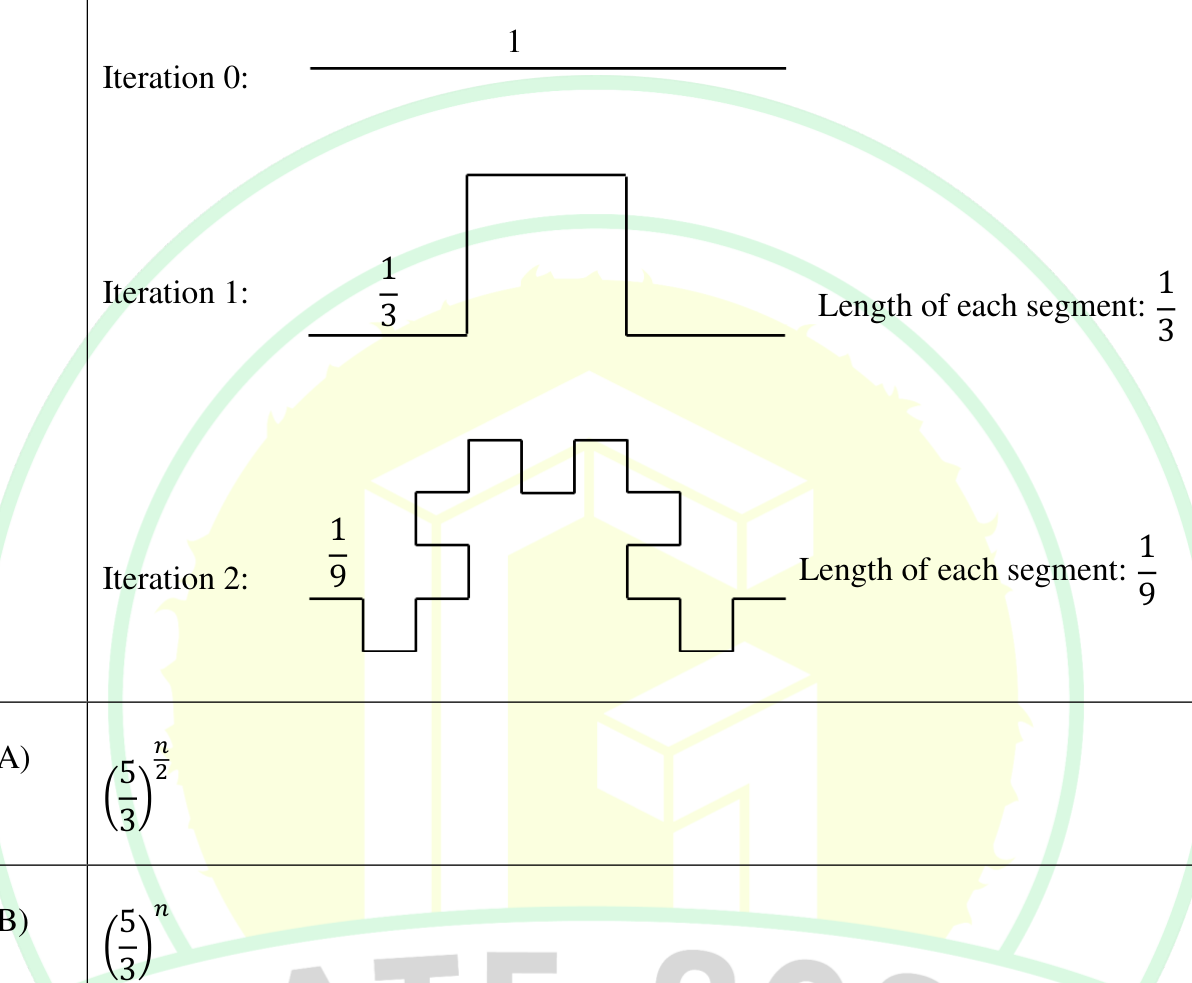
- A.
- B.✓
- C.
- D.
Answer: B
Solution
Each iteration replaces each segment so the total length is multiplied by (5 segments of length of the previous). After iterations the length is . - A.
- Question 5General Aptitudemcq2 marksIdentify the sequence that forms a coherent paragraph: P. Over time, such adaptations lead to significant evolutionary changes with the potential to shape the development of new species. Q. In the natural world, organisms constantly adapt to their environments in response to challenges and opportunities. R. This process of adaptation is driven by the principle of natural selection, where favorable traits increase an organism's chances of survival and reproduction. S. As environments change, organisms that can adapt their behavior, structure and physiology are more likely to survive.
- A.P → Q → R → S
- B.Q → S → R → P✓
- C.R → S → Q → P
- D.S → P → R → Q
Answer: B
Solution
Q introduces adaptation, S elaborates on surviving by adapting, R explains the driving principle (natural selection), and P concludes with long-term evolutionary change: Q → S → R → P. - A.
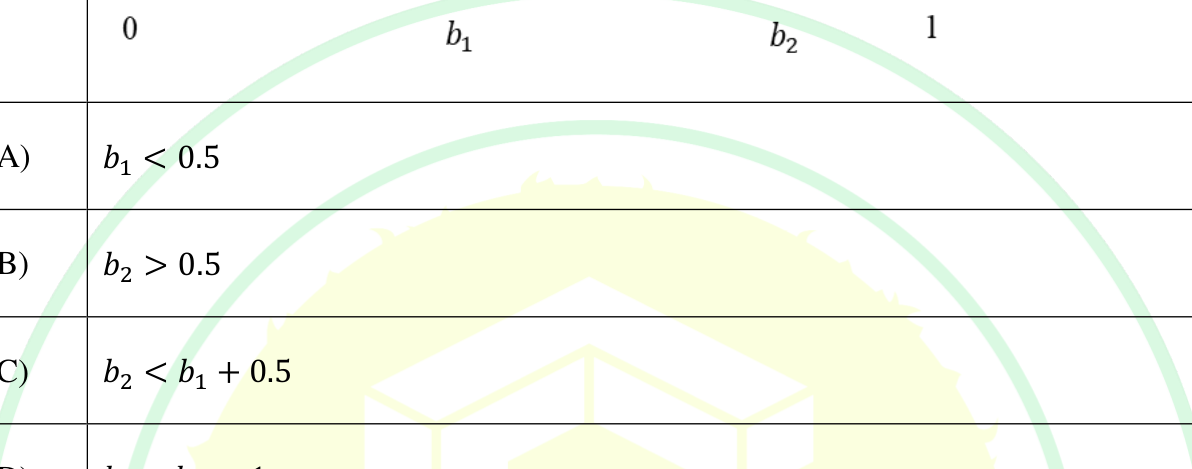
- Question 6General Aptitudemcq2 marksA one-metre stick is broken at distances and from the origin, (see figure). The three pieces are , , . Which is NOT a necessary condition for forming a triangle?
- A.
- B.
- C.
- D.✓
Answer: D
Solution
The triangle inequalities on the three pieces require each piece : (A), (B), and (C). The condition (D) is not one of the required inequalities. - A.
- Question 7General Aptitudemcq2 marksEight students P, Q, R, S, T, U, V, W play musical chairs, positioned around a circle (see figure), moving clockwise. After round 1, the 4th student behind P leaves; after round 2, the 5th behind Q leaves; after round 3, the 3rd behind V leaves; after round 4, the 4th behind U leaves. Who are left after the 4th round?
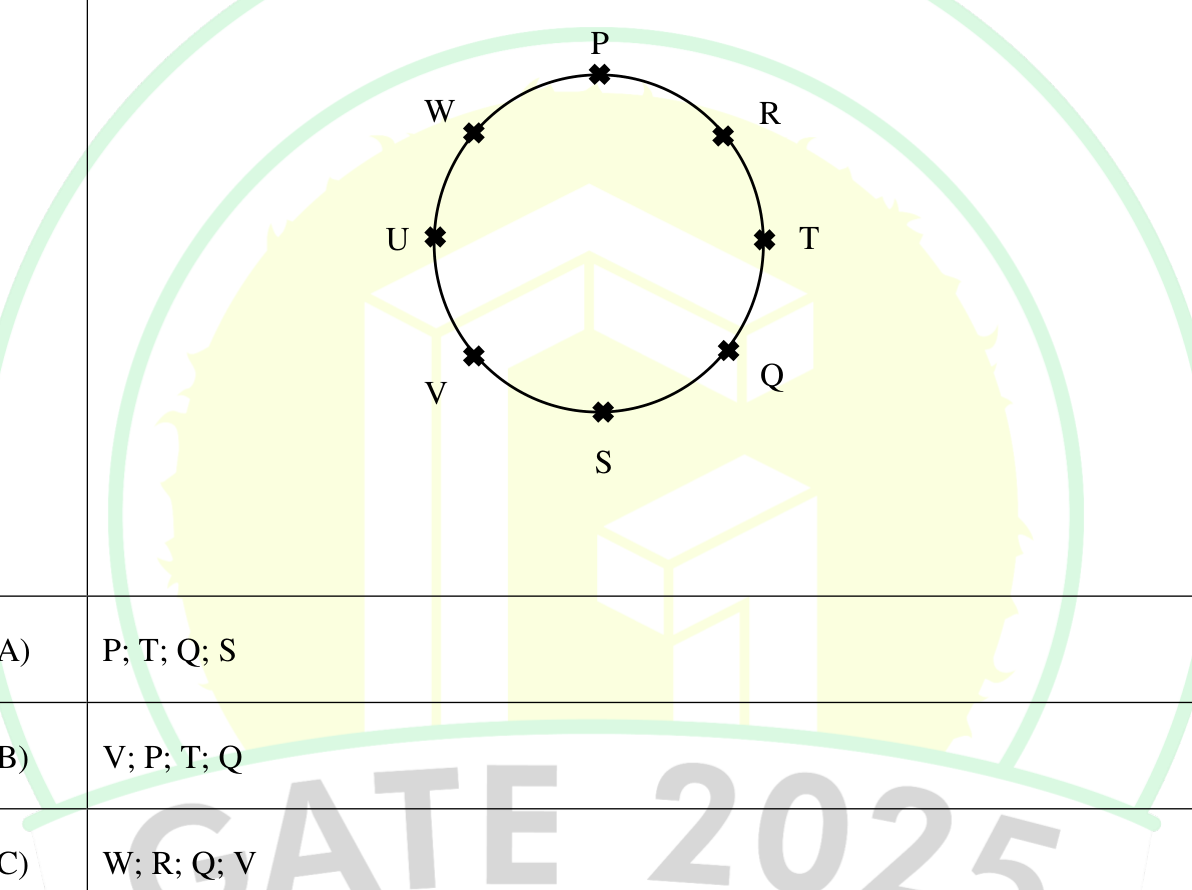
- A.P; T; Q; S
- B.V; P; T; Q
- C.W; R; Q; V
- D.Q; T; V; W✓
Answer: D
Solution
Tracking "nth student behind X" clockwise around the circle and removing one student each round, the four students remaining after round 4 are Q, T, V, W. - A.
- Question 8General Aptitudemcq2 marksTop-5 nations by gold medals:
Based only on this data, which statement is INCORRECT?Nation Gold Silver Bronze USA 40 44 41 Canada 39 27 24 Japan 20 12 13 Australia 17 19 16 France 16 26 22- A.France will occupy the third place if ranked by total medals.✓
- B.The order of the top two nations will not change if ranked by total medals.✓
- C.USA and Canada together have less than 50% of the medals awarded to these nations.✓
- D.Canada has won twice as many total medals as Japan.✓
Answer: A, B, C, D
Solution
Totals: USA 125, Canada 90, Japan 45, Australia 52, France 64. Canada (90) is exactly twice Japan (45) — (D) correct. France (64) ranks third by total — (A) correct. USA+Canada =215 of 376 total =57% (>50%), so (C) is INCORRECT. The top two (USA, Canada) stay ordered — (B) correct. Note: the official GATE answer was "Marks to All" for this question. - A.
- Question 9General Aptitudemcq2 marksAn organization charges overhead on a consulting fee: 20% of the fee if the fee ₹5,00,000; otherwise ₹1,00,000 plus 10% of the amount above ₹5,00,000. GST of 18% applies on (fee + overhead). The client can pay at most ₹10,00,000. The maximum consulting fee the employee can charge is:
- A.₹7,01,438
- B.₹7,24,961✓
- C.₹7,51,232
- D.₹7,75,784
Answer: B
Solution
For fee : total . Solving: . - A.
- Question 10Engineering Mathematicsmcq1 markConsider the matrix . For which combinations of is the rank of at least three? (i) and (ii) (iii) and (iv)
- A.Only (i), (iii), and (iv)✓
- B.Only (iv)
- C.Only (ii)
- D.Only (i) and (iii)
Answer: A
Solution
The first two rows are independent (rank 2). A third independent row requires row 3 or row 4 to be nonzero and independent. In case (ii) both are zero so rank stays 2. In cases (i), (iii) and (iv) at least one of rows 3/4 is nonzero and independent of the first two, giving rank . So (i),(iii),(iv) — option (A). - A.
- Question 11Engineering Mathematicsmcq1 markConsider the series (i) , (ii) , (iii) . Choose the correct option.
- A.Only (ii) converges
- B.Only (ii) and (iii) converge✓
- C.Only (iii) converges
- D.All three converge
Answer: B
Solution
(i) is a -series with — diverges. (ii) telescopes to 1 — converges. (iii) converges to . So only (ii) and (iii) converge. - A.
- Question 12Engineering Mathematicsmcq1 markA pot has two red and two blue balls. Two balls are drawn without replacement. The probability that the two balls have different colours is:
- A.✓
- B.
- C.
- D.
Answer: A
Solution
Favorable (one red, one blue) ; total . Probability . - A.
- Question 13Communicationsmcq1 markAn FM signal is , with . The peak frequency deviation (in Hz) is:
- A.✓
- B.
- C.
- D.
Answer: A
Solution
Instantaneous frequency deviation . Peak . - A.
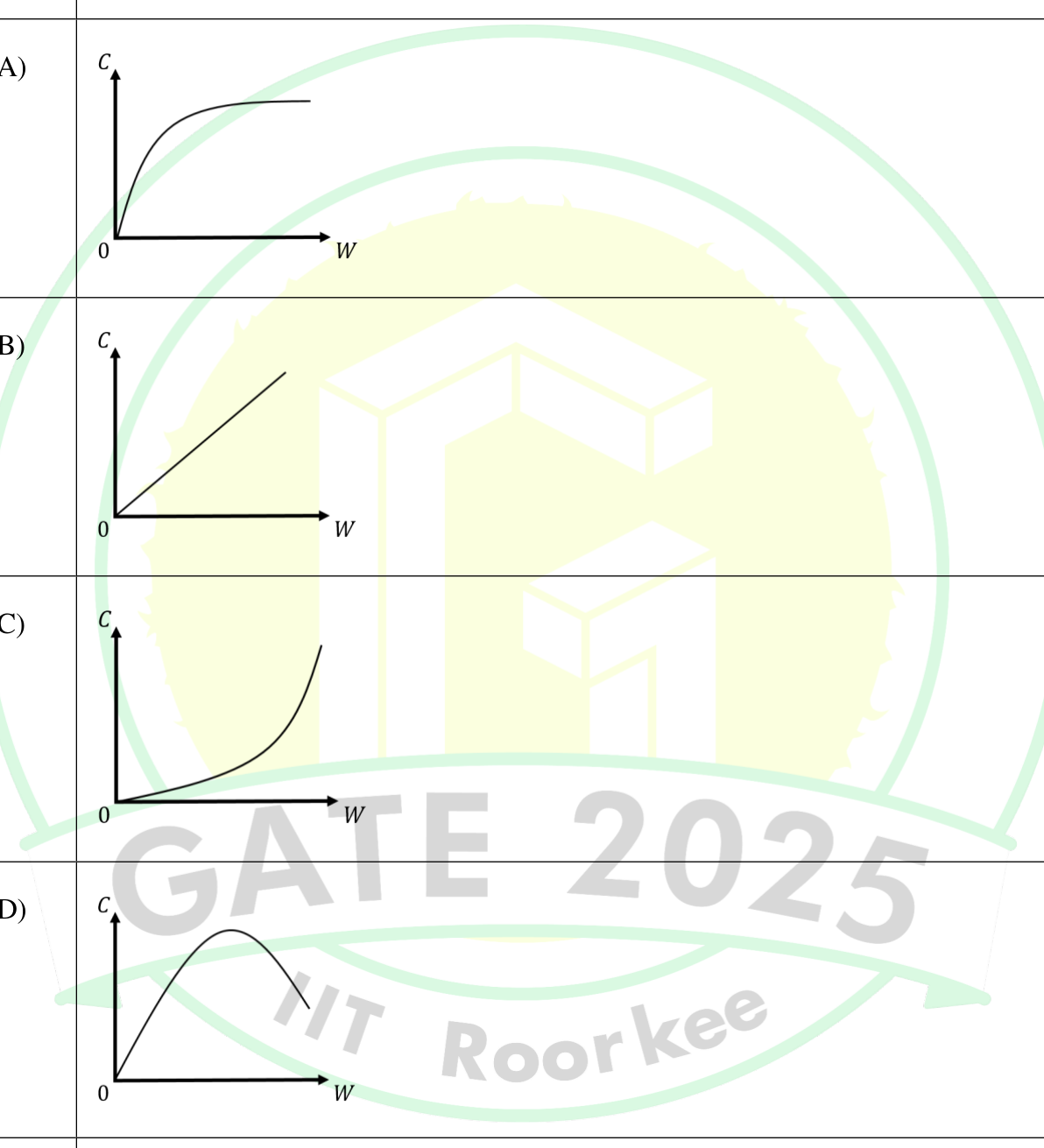
- Question 14Communicationsmcq1 markFor an AWGN channel with bandwidth , noise PSD and average power constraint , which plot shows the dependence of capacity on (with fixed)? (See figure.)
- A.(A)✓
- B.(B)
- C.(C)
- D.(D)
Answer: A
Solution
Capacity increases with but saturates to as — the concave, saturating curve, option (A). - A.
- Question 15Control Systemsmcq1 markThe Nyquist plot of a system is given (points P, Q, R, S at positive frequencies ). Which statement is TRUE? (See figure.)
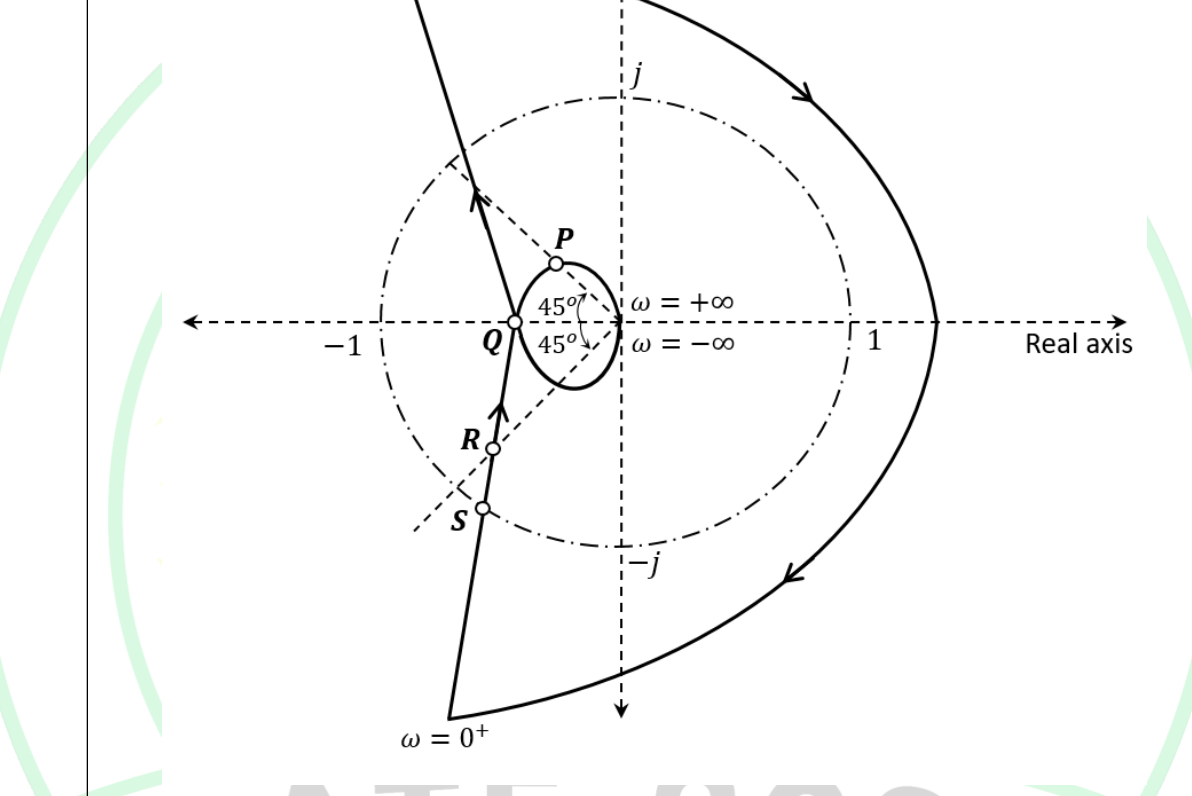
- A.is the gain crossover and is the phase crossover frequency
- B.is the gain crossover and is the phase crossover frequency
- C.is the gain crossover and is the phase crossover frequency
- D.is the gain crossover and is the phase crossover frequency✓
Answer: D
Solution
The gain crossover is where (the plot crosses the unit circle) and the phase crossover is where the phase is (the plot crosses the negative real axis). Reading these from the figure gives (gain crossover) and (phase crossover) — option (D). - A.
- Question 16Networks, Signals and Systemsmcq1 markIn the discrete-time system shown, and are impulse responses of LTI subsystems, is the unit impulse and . Assuming , the overall system (dashed box) is: (See figure.)
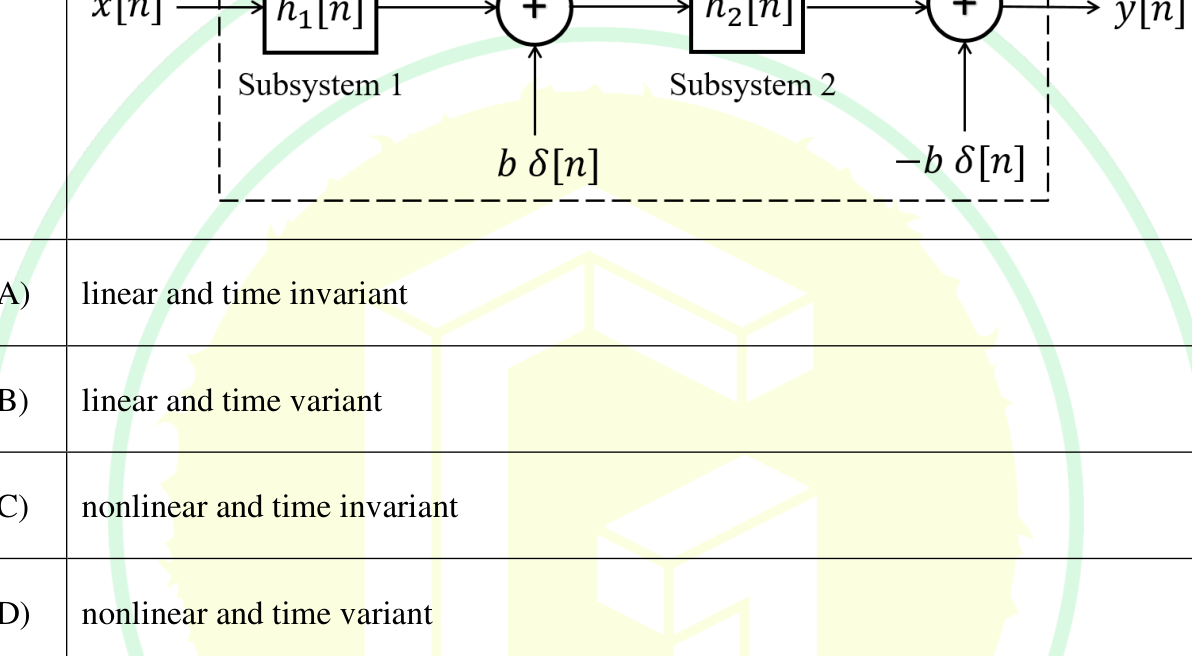
- A.linear and time invariant
- B.linear and time variant
- C.nonlinear and time invariant
- D.nonlinear and time variant✓
Answer: D
Solution
The interconnection contains a multiplication of the signal by (or a similar time-dependent scaling from the feedback structure shown), which makes the overall system nonlinear and time variant. - A.
- Question 17Networks, Signals and Systemsmcq1 markFor a continuous-time real-valued signal with Fourier transform , which statement is always TRUE?
- A.✓
- B.
- C.
- D.
Answer: A
Solution
by the triangle inequality for integrals. Option (A). - A.
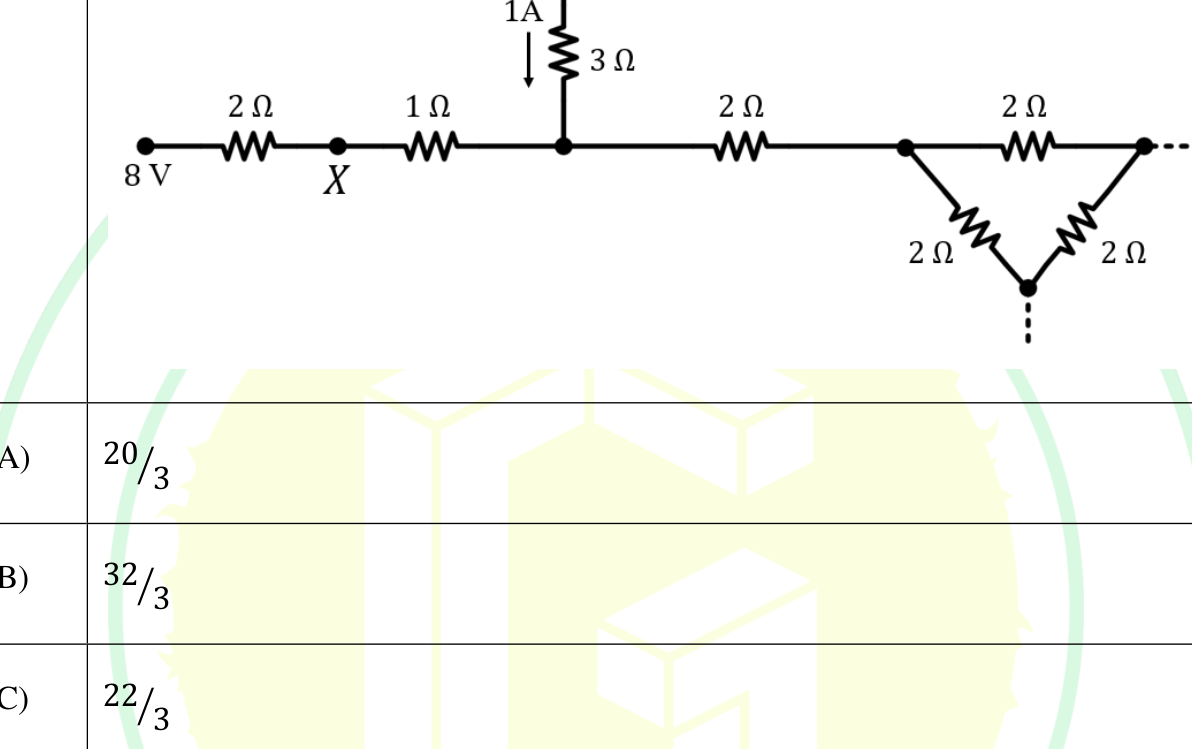
- Question 18Networks, Signals and Systemsmcq1 markPart of an electrical network is shown, with some node voltages and the current through the resistor indicated. The voltage (in Volts) at node is: (See figure.)
- A.✓
- B.
- C.
- D.
Answer: A
Solution
Applying KCL at node using the given adjacent node voltages and the stated branch current, the node voltage solves to V. - A.
- Question 19Networks, Signals and Systemsmcq1 markIn the circuit shown, , , are the currents through the capacitor, inductor and resistor; AC admittances are in Siemens. Which is TRUE? (See figure.)
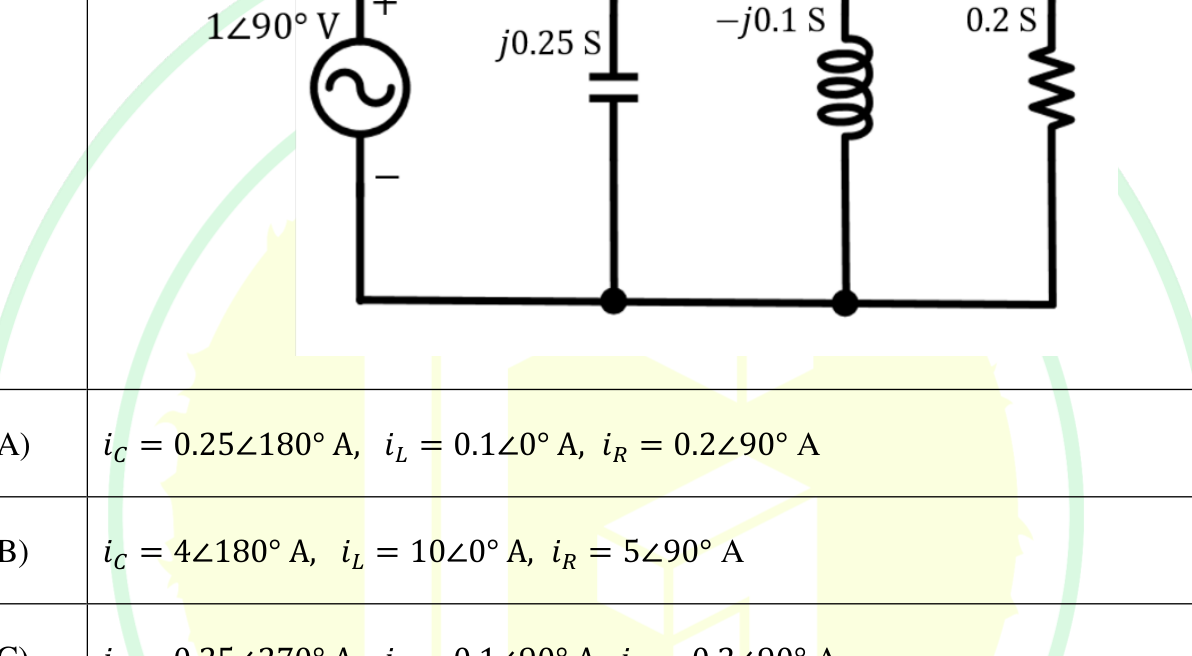
- A.A✓
- B.A
- C.A
- D.A
Answer: A
Solution
Each branch current is the branch admittance times the common node voltage. Using the given admittances and the phase of the capacitive/inductive branches relative to the resistive branch gives option (A). - A.
- Question 20Analog Circuitsmcq1 markA simplified small-signal equivalent circuit of a BJT amplifier is shown. The small-signal voltage gain (in V/V) is: (See figure.)
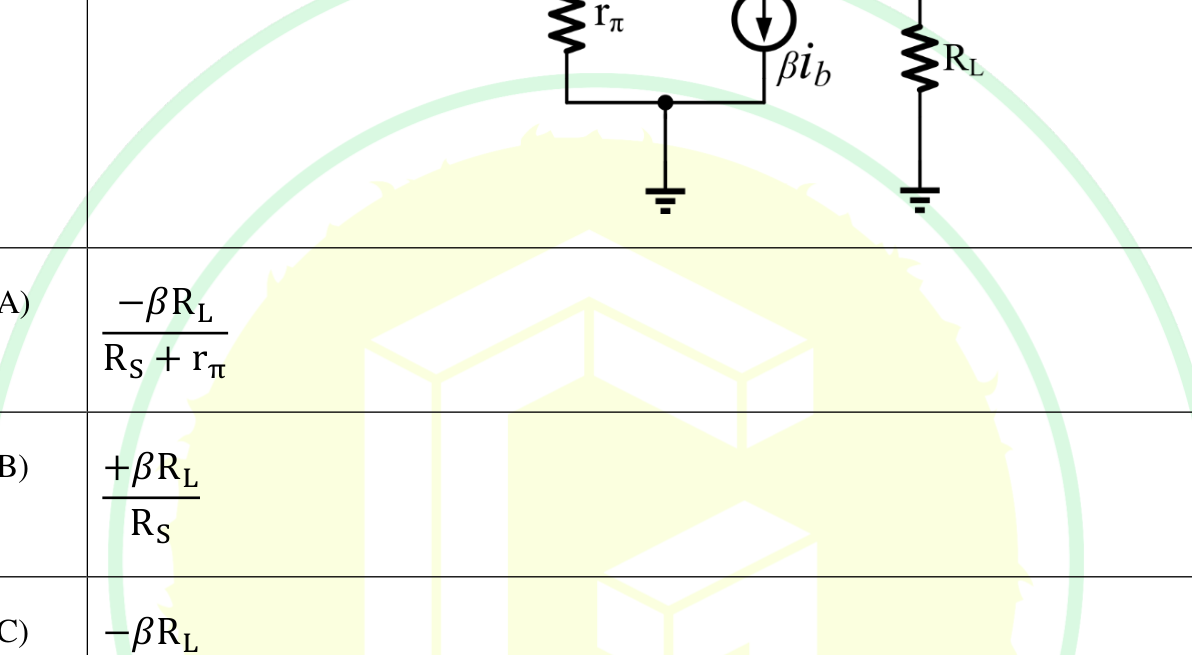
- A.✓
- B.
- C.
- D.
Answer: A
Solution
The base current is ; the collector current source drives , giving . Hence . - A.
- Question 21Analog Circuitsmcq1 markThe ideal BJT in the circuit is biased in the active region with . If A, then (in Volts, rounded to two decimals) is: (See figure.)
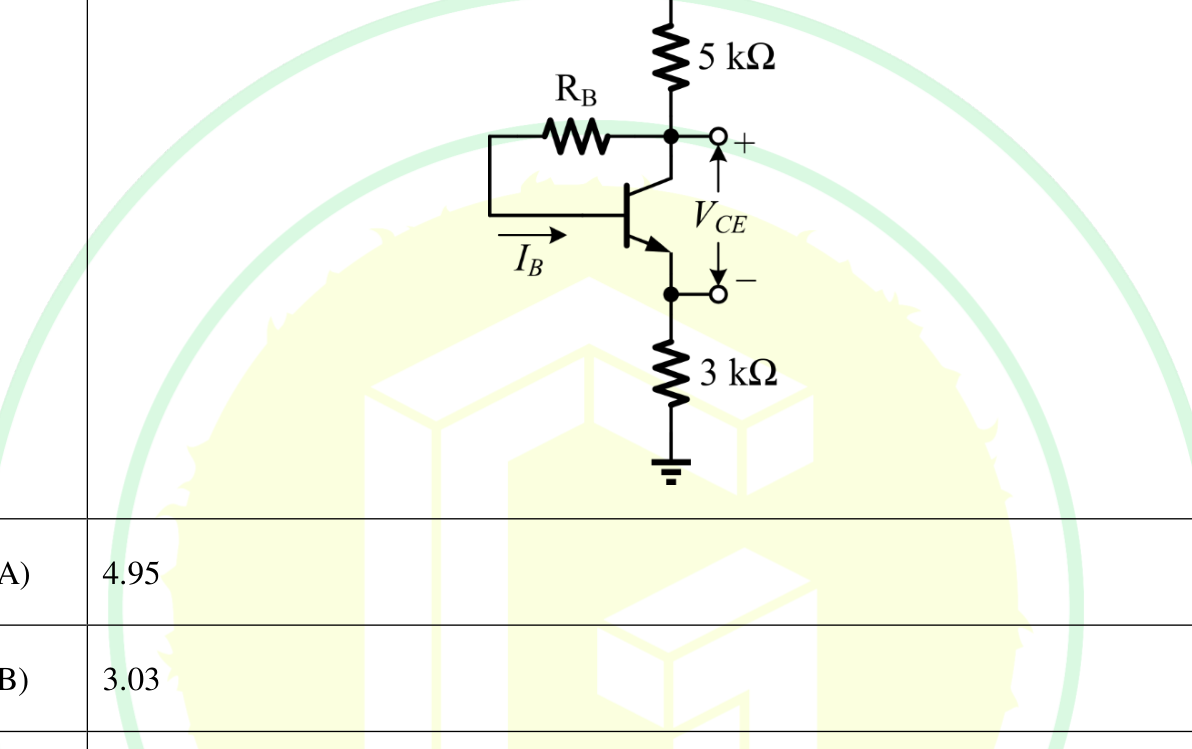
- A.4.95
- B.3.03
- C.1.92✓
- D.3.73
Answer: C
Solution
With A, mA, mA. Writing KVL around the collector loop with the and resistors, , which evaluates to V. - A.
- Question 22Digital Circuitsmcq1 markA 3-input majority gate with inputs outputs logic 1 if two or more inputs are 1. Which is the Boolean expression of the output ?
- A.✓
- B.
- C.
- D.
Answer: A
Solution
The majority function is 1 exactly when at least two inputs are 1: . - A.
- Question 23Digital Circuitsmcq1 markA full adder and an XOR gate implement a circuit with inputs X, Y, Z and output F; Z is the carry-in. If Z is set to logic 1, the circuit functions as ______ with X and Y as inputs. (See figure.)
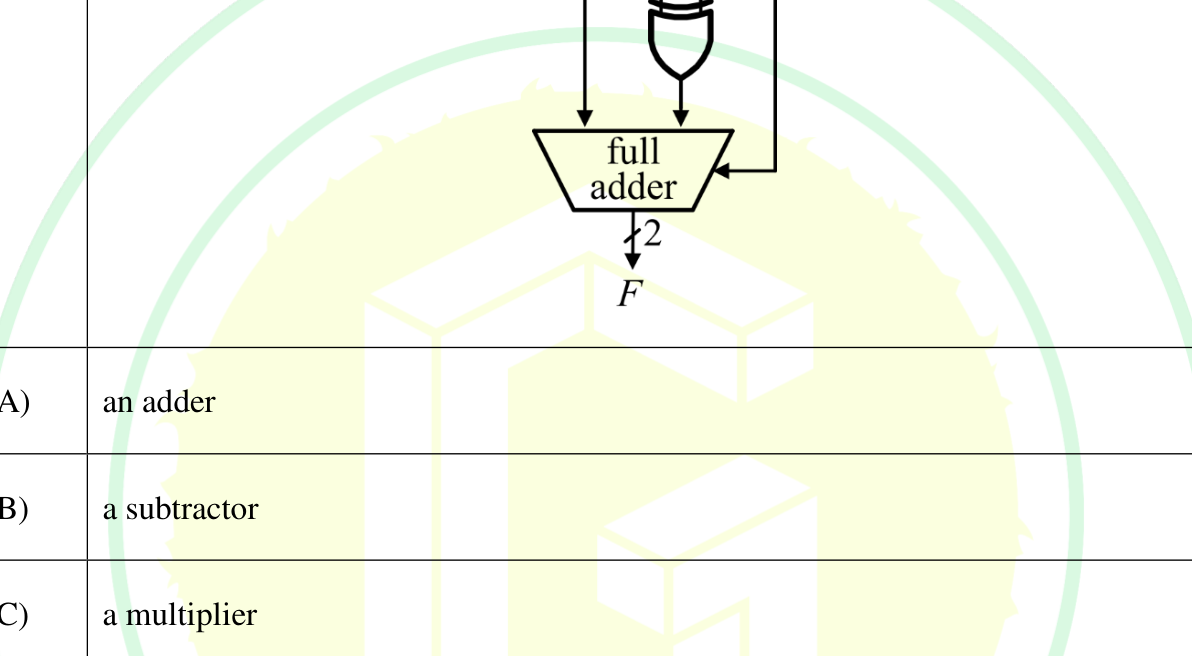
- A.an adder
- B.a subtractor✓
- C.a multiplier
- D.a binary to Gray code converter
Answer: B
Solution
With the XOR gate complementing one input and carry-in Z=1, the full adder performs (two's-complement subtraction) — the circuit acts as a subtractor. - A.
- Question 24Engineering Mathematicsmsq1 markFor , , which statement(s) is/are correct?
- A.has no global maximizer✓
- B.has no global minimizer✓
- C.is a local minimizer of
- D.is a local maximizer of
Answer: A, B
Solution
As , (no global max — A true); as , (no global min — B true). ; so is a local MAX (C false) and so is a local MIN (D false). - A.
- Question 25Control Systemsmsq1 markFor the unity-negative-feedback system in Figure (i) with gain , whose root locus is shown in Figure (ii), for what value(s) of will the system have a pole at ? (See figure.)
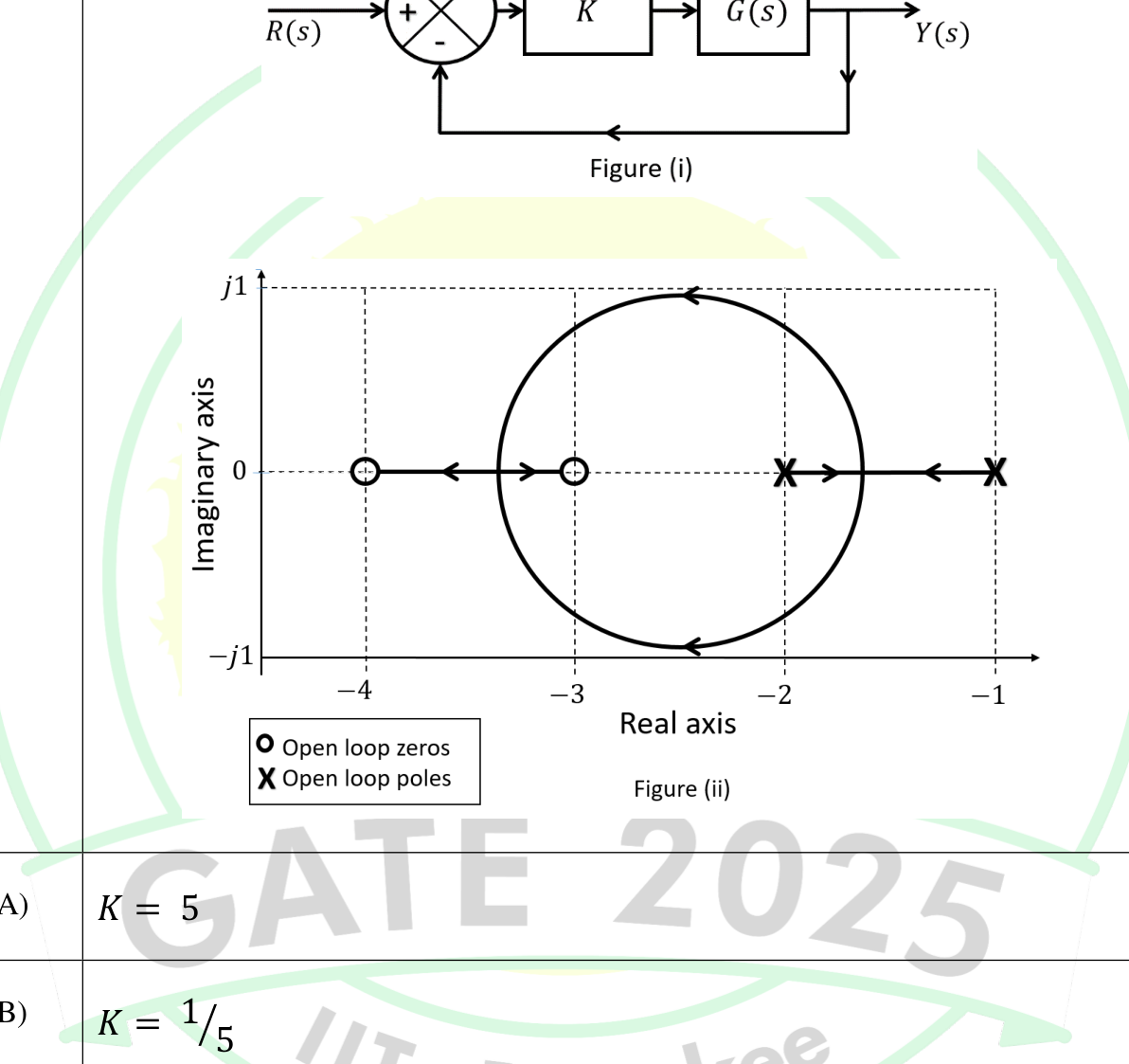
- A.
- B.
- C.For no positive value of✓
- D.For all positive values of
Answer: C
Solution
The point does not lie on the branches of the given root locus, so no positive gain places a closed-loop pole there. - A.
- Question 26Networks, Signals and Systemsmsq1 markLet have -transform . Which statement(s) is/are TRUE?
- A.The DTFT of always exists
- B.The RoC of contains neither poles nor zeros
- C.The DTFT exists if the RoC contains the unit circle✓
- D.If , the RoC is the entire -plane✓
Answer: C, D
Solution
The DTFT does not always exist (A false). The RoC never contains poles, but it can contain zeros, so (B) is false. The DTFT exists iff the unit circle is in the RoC (C true). For , , RoC is the whole plane (D true). - A.
- Question 27Communicationsmsq1 markFor message bandlimited to : DSB-SC is and AM is . Statements: (i) an envelope detector can demodulate DSB-SC if for all ; (ii) an envelope detector can demodulate AM only if for all . Which option(s) is/are correct?
- A.(i) is TRUE✓
- B.(i) is FALSE
- C.(ii) is TRUE
- D.(ii) is FALSE✓
Answer: A, D
Solution
If always, the DSB-SC envelope equals , so (i) is TRUE (A). AM only needs (i.e. ), not , so the "only if " claim is FALSE (D). Correct: (A),(D). - A.
- Question 28Analog Circuitsmsq1 markWhich statement(s) is/are TRUE for an ideal op-amp?
- A.It has an infinite input resistance✓
- B.It has an infinite output resistance
- C.It has an infinite open-loop differential gain✓
- D.It has an infinite open-loop common-mode gain
Answer: A, C
Solution
An ideal op-amp has infinite input resistance (A), zero (not infinite) output resistance (B false), infinite open-loop differential gain (C) and zero common-mode gain / infinite CMRR (D false). Correct: (A),(C). - A.
- Question 29Analog Circuitsmsq1 markWhich statement(s) is/are TRUE for ideal MOSFET DC-coupled single-stage amplifiers with finite load resistors?
- A.The common-gate amplifier has infinite input resistance
- B.The common-source amplifier has infinite input resistance✓
- C.Input and output voltages of the common-source amplifier are in phase
- D.Input and output voltages of the common-drain amplifier are in phase✓
Answer: B, D
Solution
The gate draws no DC current, so common-source has infinite input resistance (B true); common-gate has a low input resistance (A false). Common-source is inverting (C false); common-drain (source follower) is non-inverting, i.e. in phase (D true). Correct: (B),(D). - A.
- Question 30Electronic Devicesmsq1 markWhich of the following can be used as an n-type dopant for silicon? Select the correct option(s).
- A.Arsenic✓
- B.Boron
- C.Gallium
- D.Phosphorous✓
Answer: A, D
Solution
n-type dopants for silicon are pentavalent (Group V): Arsenic (A) and Phosphorous (D). Boron and Gallium are trivalent (Group III) p-type dopants. - A.
- Question 31Engineering Mathematicsnat1 markThe function satisfies , with and . The maximum value of over is ______. (rounded off to two decimal places)
Answer: 0.25
Solution
This Cauchy-Euler equation has solutions and , so . Using the derivative conditions gives , and the maximum of on is . - Question 32Communicationsnat1 markThe generator matrix of a binary linear block code is . The minimum Hamming distance between codewords is ______. (answer in integer)
Answer: 3
Solution
For a linear code, equals the minimum weight of a nonzero codeword. Generating all 7 nonzero codewords, the smallest weight is 3. - Question 33Analog Circuitsnat1 markAll components in the bandpass filter shown are ideal. The lower dB frequency is 1 MHz. The upper dB frequency (in MHz, rounded to the nearest integer) is ______. (See figure.)
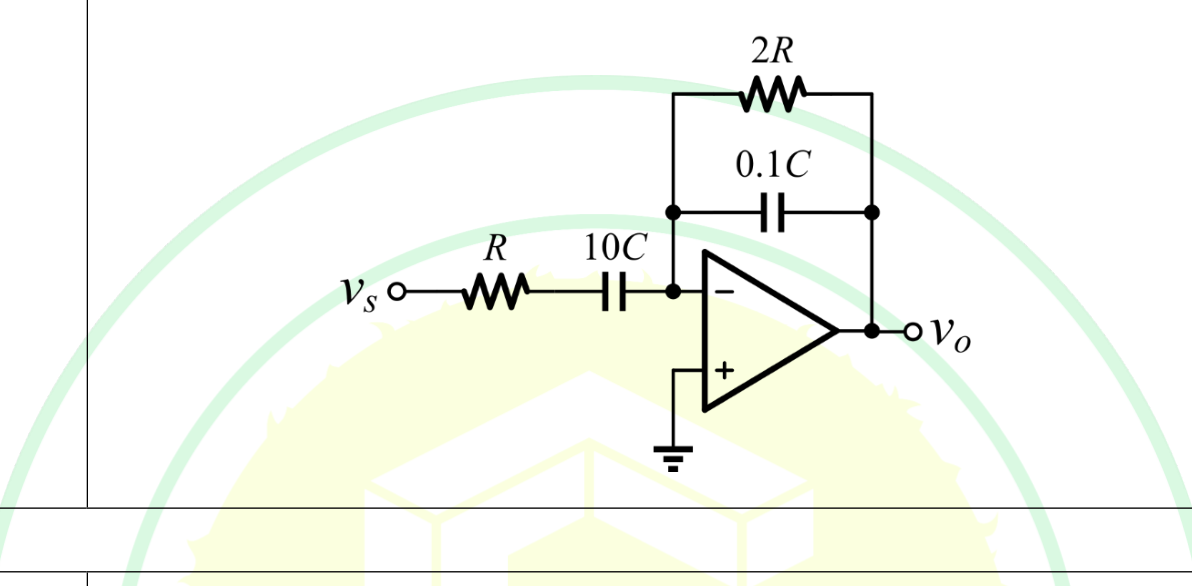
Answer: 50
Solution
From the active-filter component values in the figure, the lower cutoff is set by one RC product and the upper cutoff by another; given the lower cutoff is 1 MHz, the component ratios make the upper dB frequency 50 MHz. - Question 34Digital Circuitsnat1 markA 4-bit weighted-resistor DAC (, MSB to LSB) uses an ideal op-amp (see figure). When the input changes from to , the magnitude of the change in output voltage (in mV, rounded to the nearest integer) is ______.
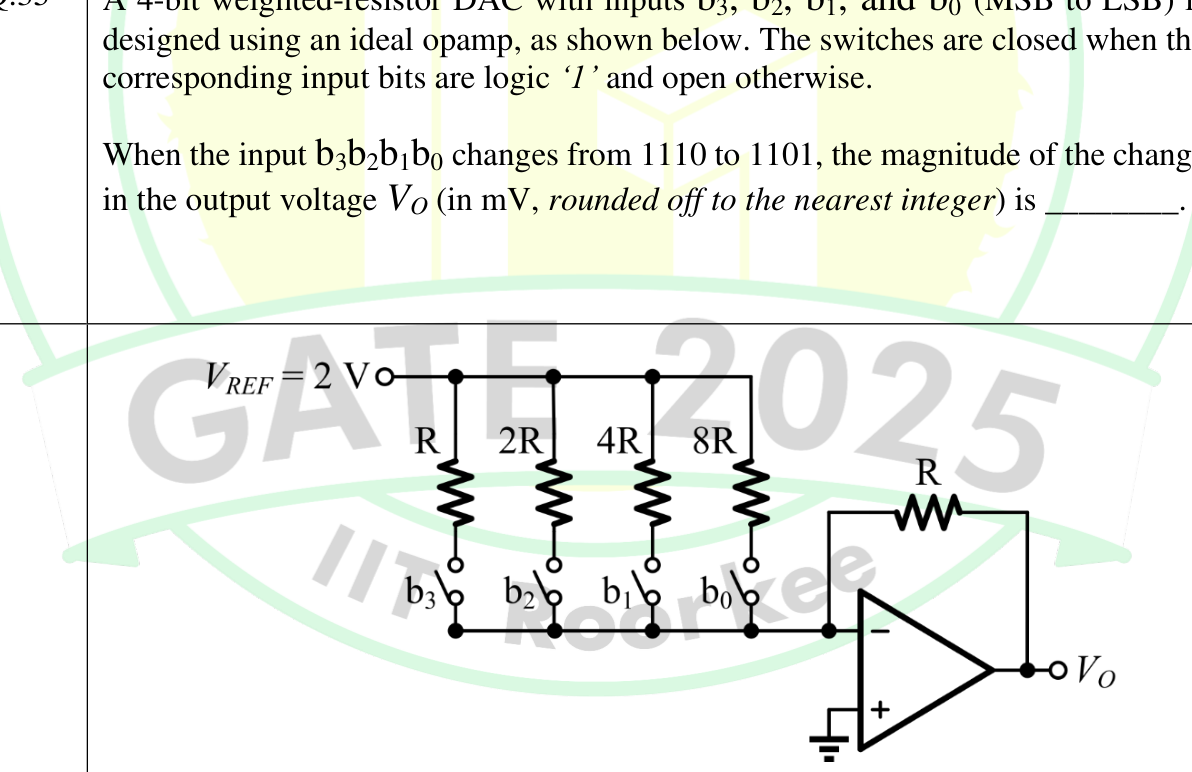
Answer: 250
Solution
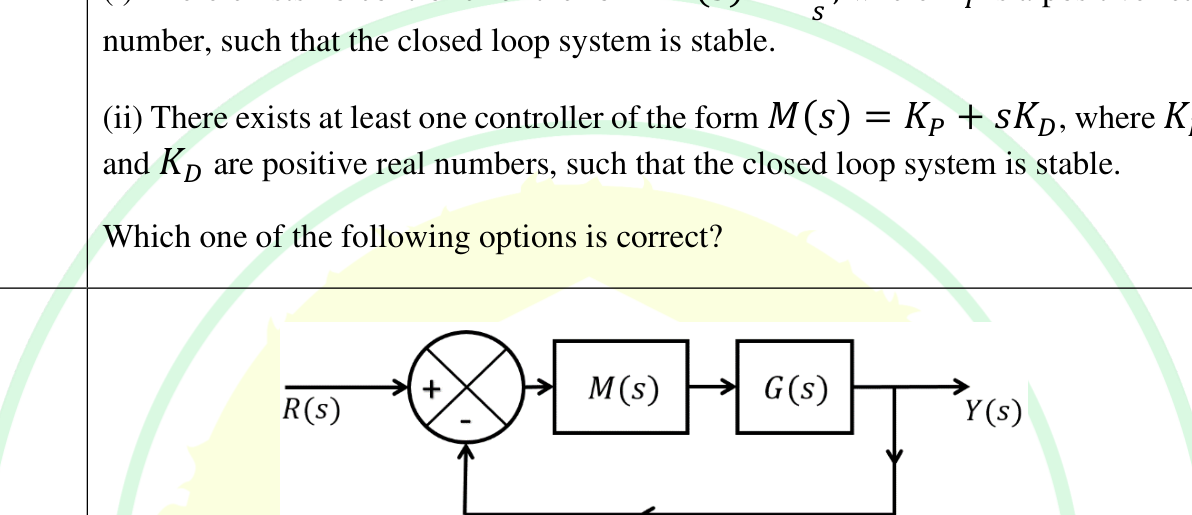
Changing from to changes the weighted sum by one LSB step times the difference in the vs contributions. With V and the shown resistor weights, mV. - Question 35Control Systemsmcq2 marksLet . A controller is connected as shown. (i) There exists no controller () making the closed loop stable. (ii) There exists at least one controller () making the closed loop stable. Which option is correct? (See figure.)
- A.(i) is TRUE and (ii) is FALSE
- B.(i) is FALSE and (ii) is TRUE
- C.Both (i) and (ii) are FALSE
- D.Both (i) and (ii) are TRUE✓
Answer: D
Solution
With , the loop is — characteristic has roots that are never all in the LHP, so no stabilizing exists (i true). With PD control , the characteristic has all positive coefficients, hence stable for suitable positive (ii true). Both true. - A.
- Question 36Control Systemsmcq2 marksFor , let be the number of roots with negative real part, purely imaginary, and positive real part respectively. Which option is correct?
- A.✓
- B.
- C.
- D.
Answer: A
Solution
Constructing the Routh array (handling the row of zeros via the auxiliary polynomial) reveals a pair of purely imaginary roots (), two LHP roots () and one RHP root (). - A.
- Question 37Networks, Signals and Systemsmcq2 marksA finite-energy signal has Fourier transform vanishing outside . It is sampled as with (), then filtered by an ideal LPF (cutoff , passband gain ). The filter output is:
- A.if✓
- B.if
- C.if
- D.if
Answer: A
Solution
The shifted impulse train samples at instants offset by , but since the sampling is periodic and the LPF reconstructs the baseband spectrum (with gain compensating the factor), the output is itself, provided no aliasing: . Option (A). - A.
- Question 38Networks, Signals and Systemsmcq2 marksIn the circuit, is an ideal AC voltmeter and an ideal AC ammeter; V. What value of the variable capacitor makes the RMS readings of and equal to 25 V and 5 A respectively? (See figure.)
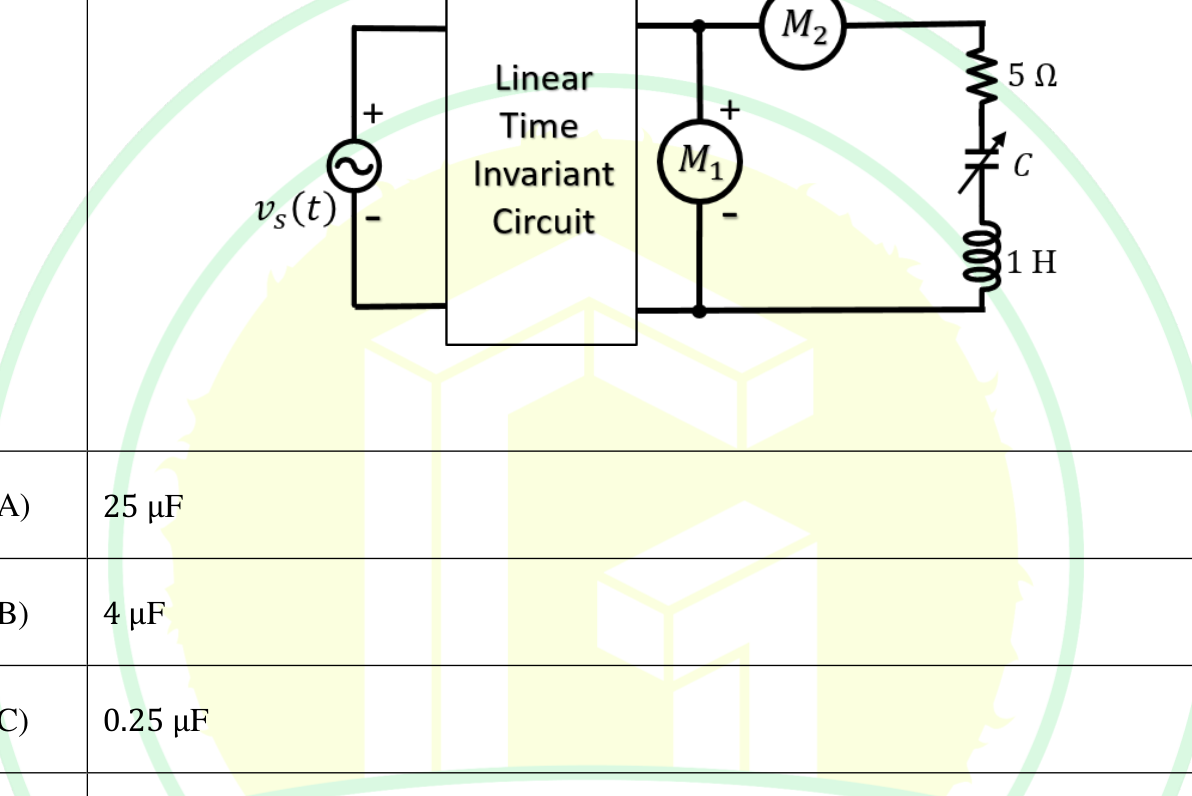
- A.25 μF✓
- B.4 μF
- C.0.25 μF
- D.Insufficient information to find
Answer: A
Solution
From the required voltmeter/ammeter readings the branch impedance magnitude and reactance are fixed; with rad/s the capacitor reactance that satisfies both readings gives F. - A.
- Question 39Networks, Signals and Systemsmcq2 marksFor the two-port network shown, the Z-parameter matrix (entries in Ohms), where , is: (See figure.)
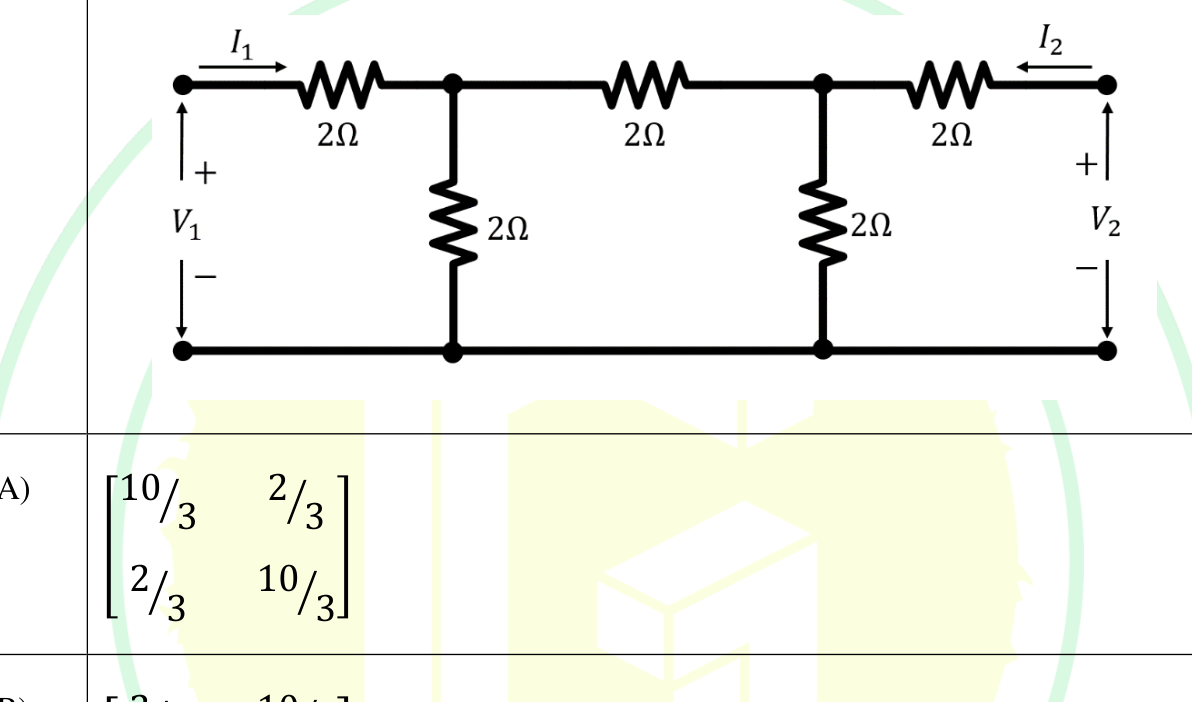
- A.✓
- B.
- C.
- D.
Answer: A
Solution
Computing , , etc. for the symmetric resistive network gives and — option (A). - A.
- Question 40Communicationsmcq2 marksA source transmits uniformly; the receiver gets with zero-mean Gaussian independent of , and uses ML detection. If the symbol error probability is , the value of is:
- A.
- B.
- C.
- D.✓
Answer: D
Solution
ML thresholds are at . The two outer symbols () each have one decision boundary (error prob each); the middle symbol (0) has two boundaries (error prob ). Averaging: , so . - A.
- Question 41Communicationsmcq2 marksA random process , with for and 0 otherwise; the are pairwise independent, zero-mean, unit-variance. (i) the mean of is independent of ; (ii) the autocorrelation is independent of for all . Which option is correct?
- A.(i) is TRUE and (ii) is FALSE✓
- B.Both (i) and (ii) are TRUE
- C.Both (i) and (ii) are FALSE
- D.(i) is FALSE and (ii) is TRUE
Answer: A
Solution
Since , the mean for all — (i) TRUE. But the pulses occupy only half of each period, so the autocorrelation depends on the absolute position (the process is cyclostationary, not WSS) — (ii) FALSE. Option (A). - A.
- Question 42Analog Circuitsmcq2 marksIdentical ideal MOSFETs (saturation, mS) are in the circuit shown. Inputs: , . The output (in Volts) is: (See figure.)
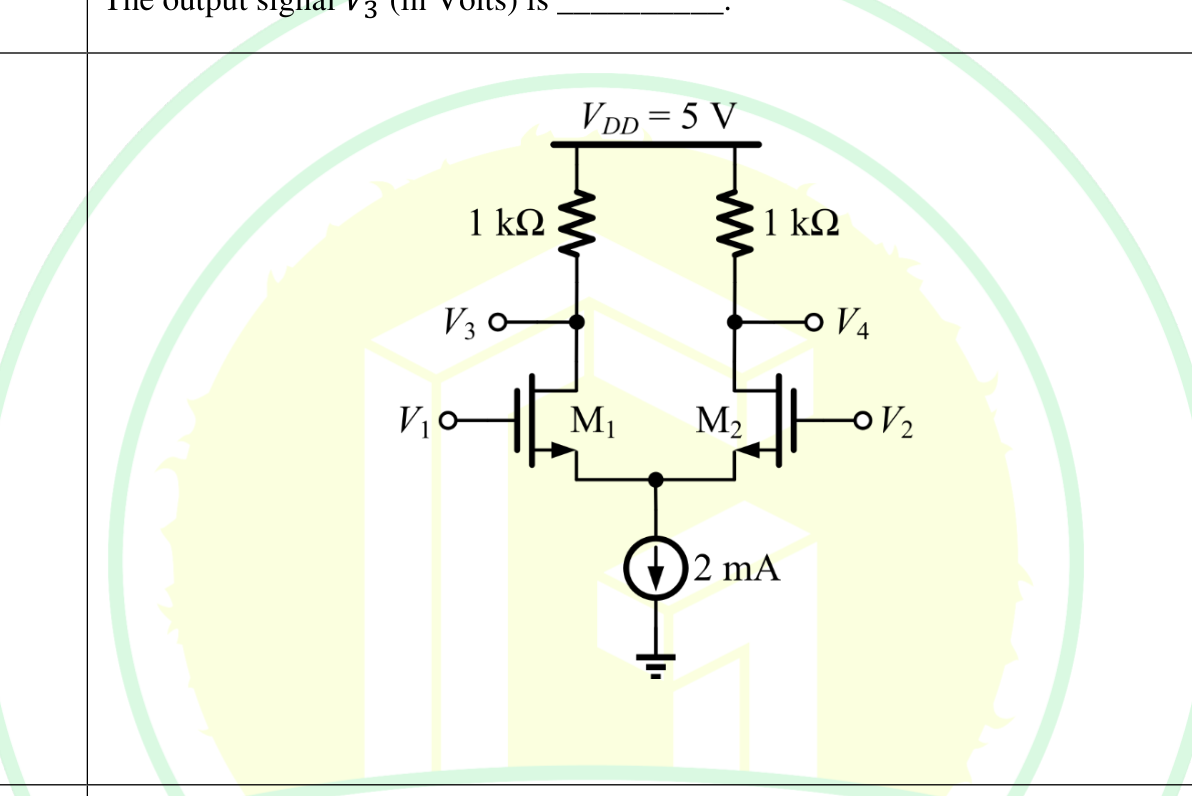
- A.
- B.
- C.
- D.✓
Answer: D
Solution
The DC output is set by the bias ( V from the figure). The differential input produces a small-signal output ; with the shown resistor the signal term is , giving . - A.
- Question 43Digital Circuitsmcq2 marksA 10-bit ADC has sampling frequency 1 MHz and full-scale voltage 3.3 V. For a 500 kHz sinusoidal input, the maximum SNR (in dB, rounded to two decimals) and the data rate (in Mbps) at the output are, respectively:
- A.61.96 and 10✓
- B.61.96 and 5
- C.33.36 and 10
- D.33.36 and 5
Answer: A
Solution
Max SNR for an -bit ADC dB. Data rate (bits/sample)(sampling rate) Mbps. Option (A). - A.
- Question 44Digital Circuitsmcq2 marksA positive-edge-triggered sequential circuit is shown (no timing violations); , at all times. The timing diagrams of inputs SEL and S are given. The sequence of output from to is: (See figure.)
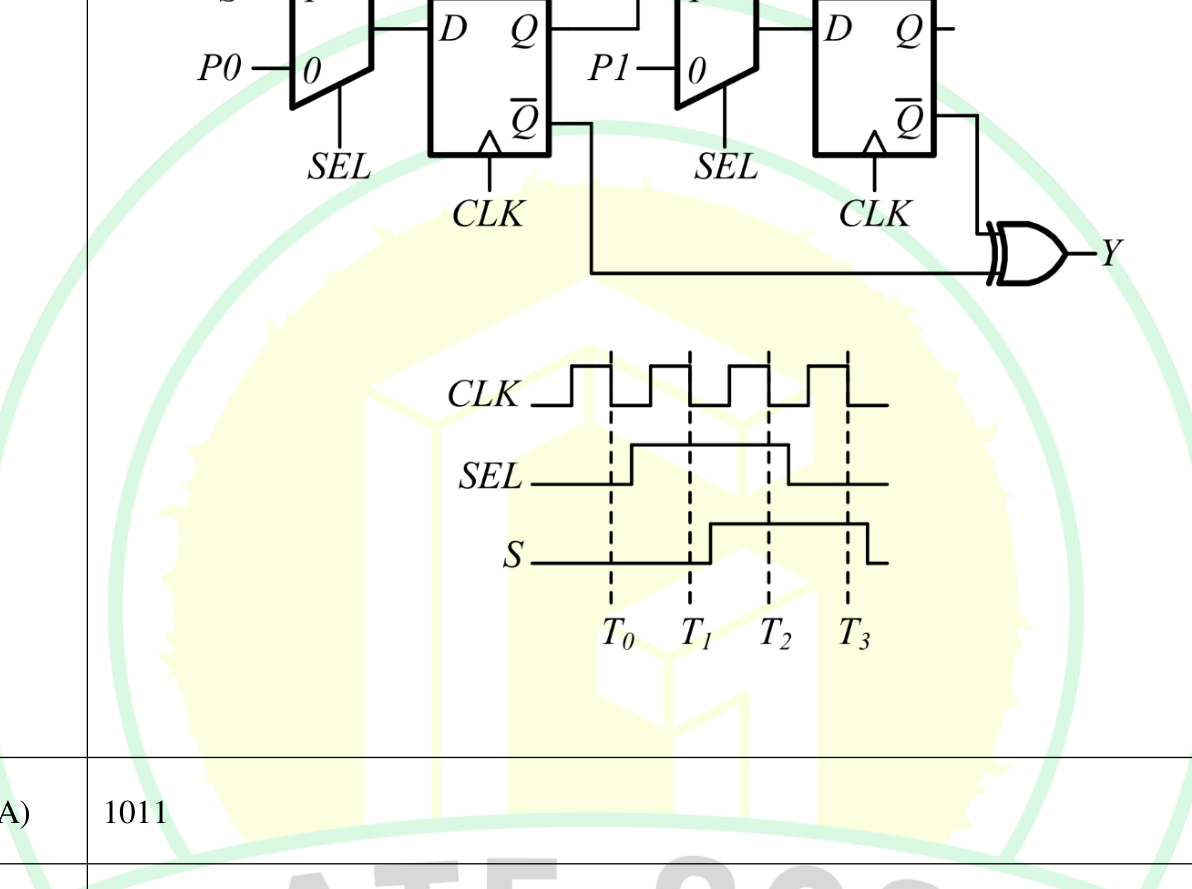
- A.1011✓
- B.0100
- C.0010
- D.1101
Answer: A
Solution
Evaluating the multiplexer/flip-flop logic at each clock edge using the given SEL and S waveforms, the output over – is . - A.
- Question 45Electronic Devicesmcq2 marksA semiconductor has intrinsic carrier concentration /m at 300 K, with electron and hole mobilities and m/Vs. The intrinsic resistivity (in m) at 300 K is ( C):
- A.1.65
- B.1.25✓
- C.0.85
- D.1.95
Answer: B
Solution
S/m. m m. - A.
- Question 46Analog Circuitsmcq2 marksIn the circuit, identical transistors are in active region with ; the Zener is in breakdown with V, mA. If mA and V, the values of and (in , rounded to one decimal) are, respectively: (See figure.)
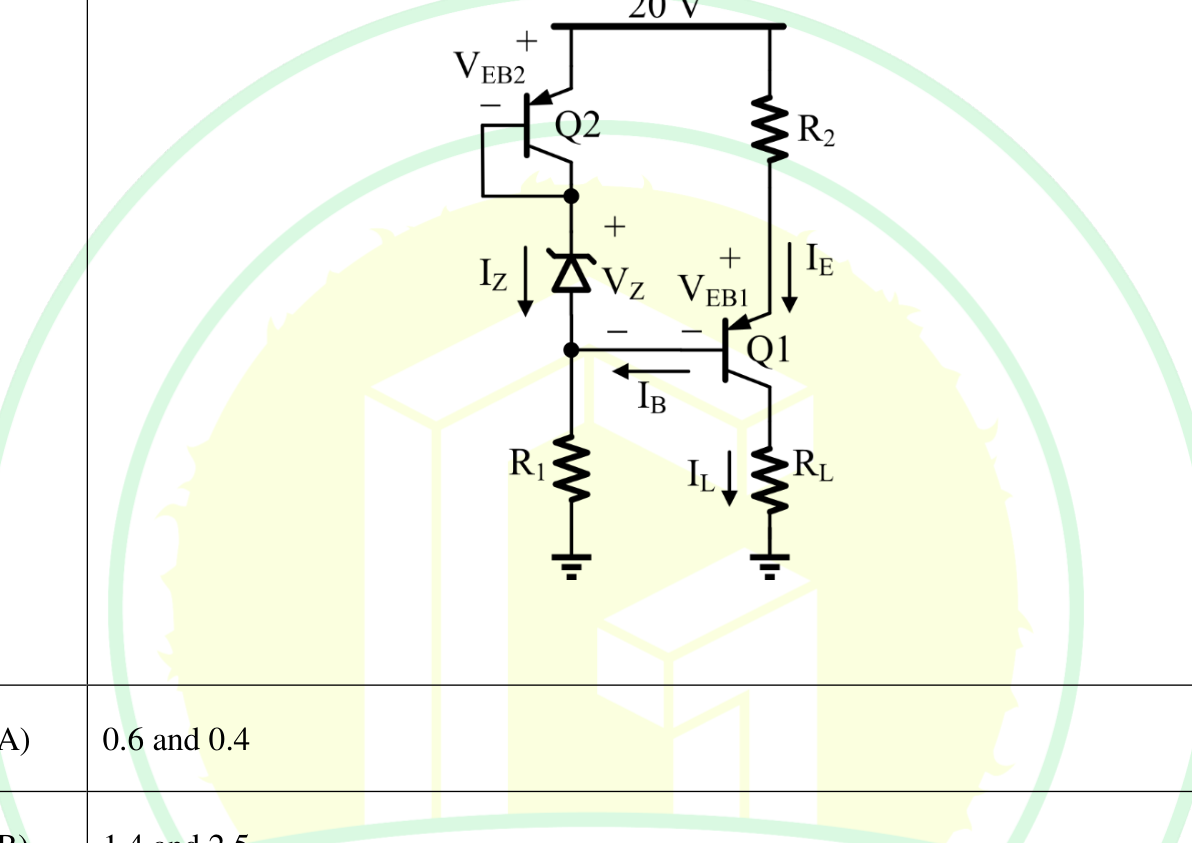
- A.0.6 and 0.4✓
- B.1.4 and 2.5
- C.14.0 and 25.0
- D.6.0 and 4.0
Answer: A
Solution
Applying KVL to the Zener/ branch (supply, , ) and to the output/ branch with the base and load currents, and solving for the resistor values gives and . - A.
- Question 47Electronic Devicesmcq2 marksElectron mobility in non-degenerate germanium at 300 K is m/Vs. The electron diffusivity at 300 K (in cm/s, rounded to the nearest integer) is ( J/K, C):
- A.26
- B.98✓
- C.38
- D.10
Answer: B
Solution
Einstein relation: m/s cm/s . - A.
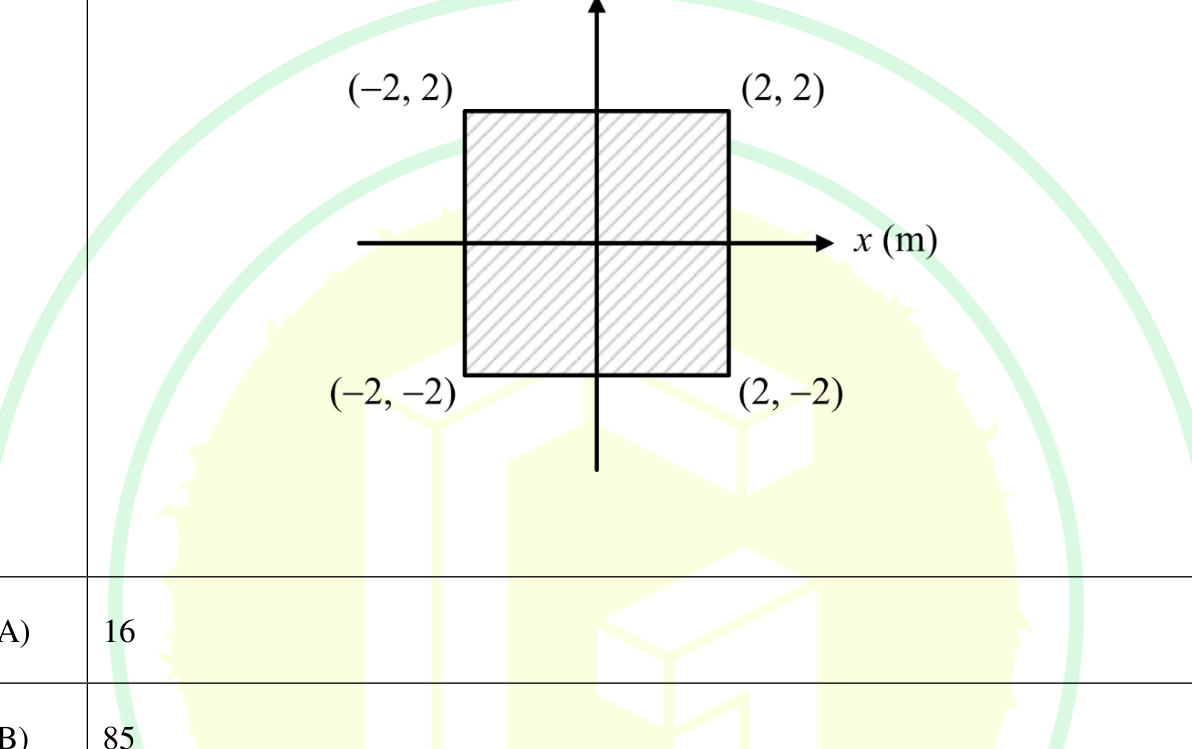
- Question 48Electromagneticsmcq2 marksA square metal sheet is on the x-y plane (see figure). If the surface charge density is C/m, the total charge (in C, rounded to nearest integer) on the sheet is:
- A.16
- B.85
- C.64✓
- D.256
Answer: C
Solution
With the sheet spanning and : C. - A.
- Question 49Electromagneticsmcq2 marksAn electric field of 0.01 V/m is applied along a copper wire of circular cross-section, diameter 1 mm, conductivity S/m. The current (in Amperes, rounded to two decimals) through the wire is:
- A.0.46✓
- B.1.82
- C.0.58
- D.1.12
Answer: A
Solution
A/m. Area m. A. - A.
- Question 50Engineering Mathematicsmsq2 marksLet be non-negative, continuous and bounded on , with maximum and minimum . For which combination(s) of is guaranteed?
- A.✓
- B.
- C.
- D.
Answer: A
Solution
The interval has width 6, so . The bound is guaranteed iff and . Only (A) (, ) satisfies both. - A.
- Question 51Engineering Mathematicsmsq2 marksWhich statement(s) about counter-clockwise contour integrals on the unit circle is/are TRUE?
- A.✓
- B., where is an even integer✓
- C.
- D.
Answer: A, B
Solution
is entire, so (A) (true). for every integer ; even excludes , so (B) is true. is entire so (C) (false). has poles at , which lie outside the unit circle, so (D false). Correct: (A),(B). - A.
- Question 52Control Systemsmsq2 marksA system has state equations . Which statement(s) is/are TRUE?
- A.The signals are bounded for all bounded inputs
- B.There exists a bounded input such that at least one of is unbounded✓
- C.There exists a bounded input such that are all unbounded
- D.The signals are unbounded for all bounded inputs
Answer: B
Solution
has eigenvalue (unstable) and has eigenvalue (integrator) — a bounded input makes (or ) unbounded, so (B) is true. (eigenvalue ) stays bounded for any bounded input, so not all three can be unbounded — (A),(C),(D) false. - A.
- Question 53Communicationsmsq2 markstakes values in with and , . Let be the entropy (in bits). Which statement(s) is/are TRUE?
- A.
- B.✓
- C.✓
- D.
Answer: B, C
Solution
Entropy is maximized at the uniform distribution . is closer to than , so (B). is also closer to than , so (C). Correct: (B),(C). - A.
- Question 54Networks, Signals and Systemsmsq2 marksLet be periodic with fundamental period and , . With and , which statement(s) is/are TRUE?
- A.for all✓
- B.is periodic with fundamental period
- C.for all
- D.is periodic with fundamental period✓
Answer: A, D
Solution
Time scaling compresses the period to (D true) but leaves the Fourier coefficients unchanged, (A true). Options (B),(C) are false. - A.
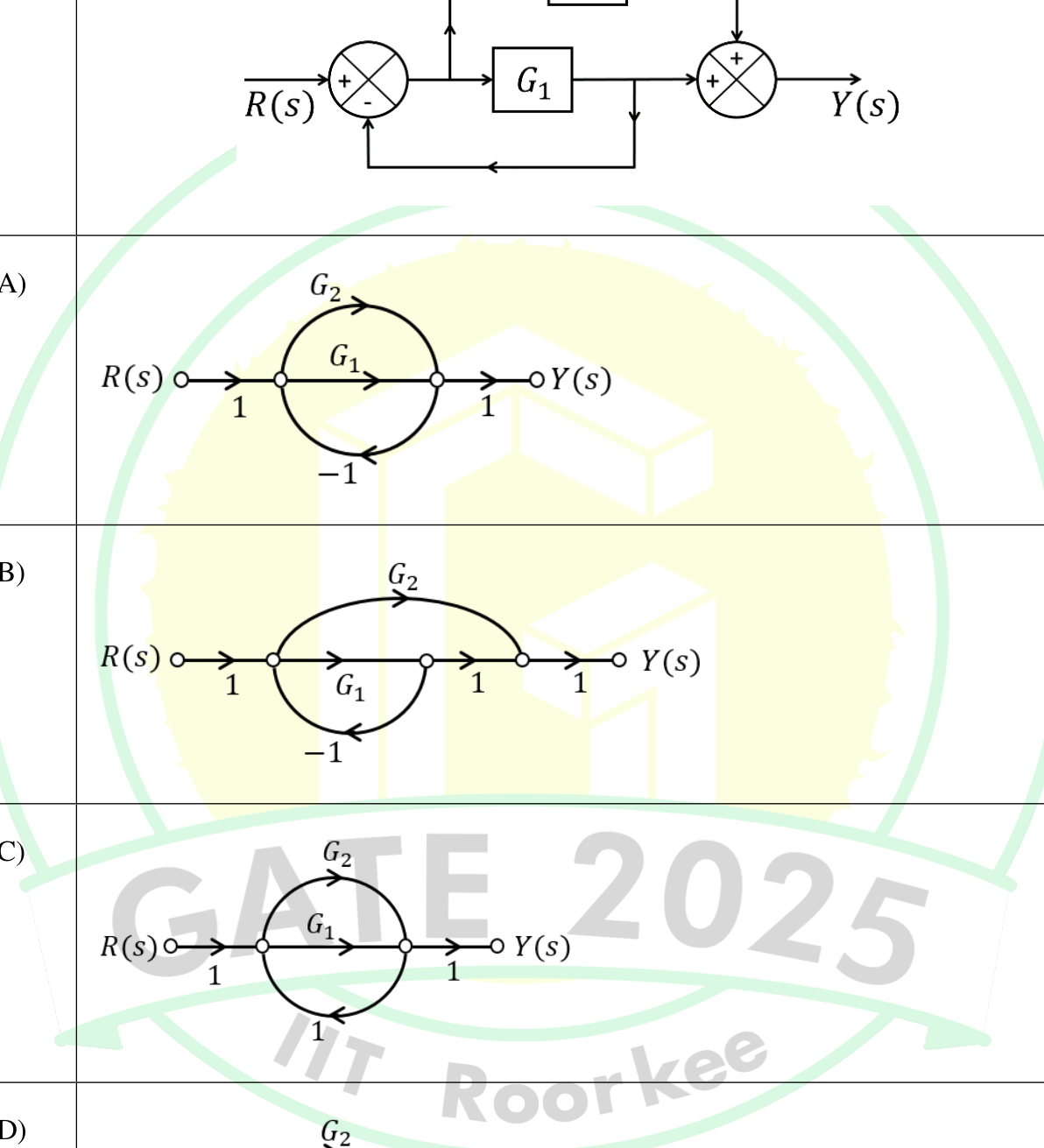
- Question 55Control Systemsmsq2 marksConsider the system represented by the block diagram shown. Which of the following signal flow graphs represent(s) this system? Choose the correct option(s). (See figure.)
- A.(A)
- B.(B)✓
- C.(C)
- D.(D)
Answer: B
Solution
Translating the block diagram's forward paths and feedback loops into nodes and branches, only signal flow graph (B) preserves the same transfer function (same path gains and loop gains). - A.
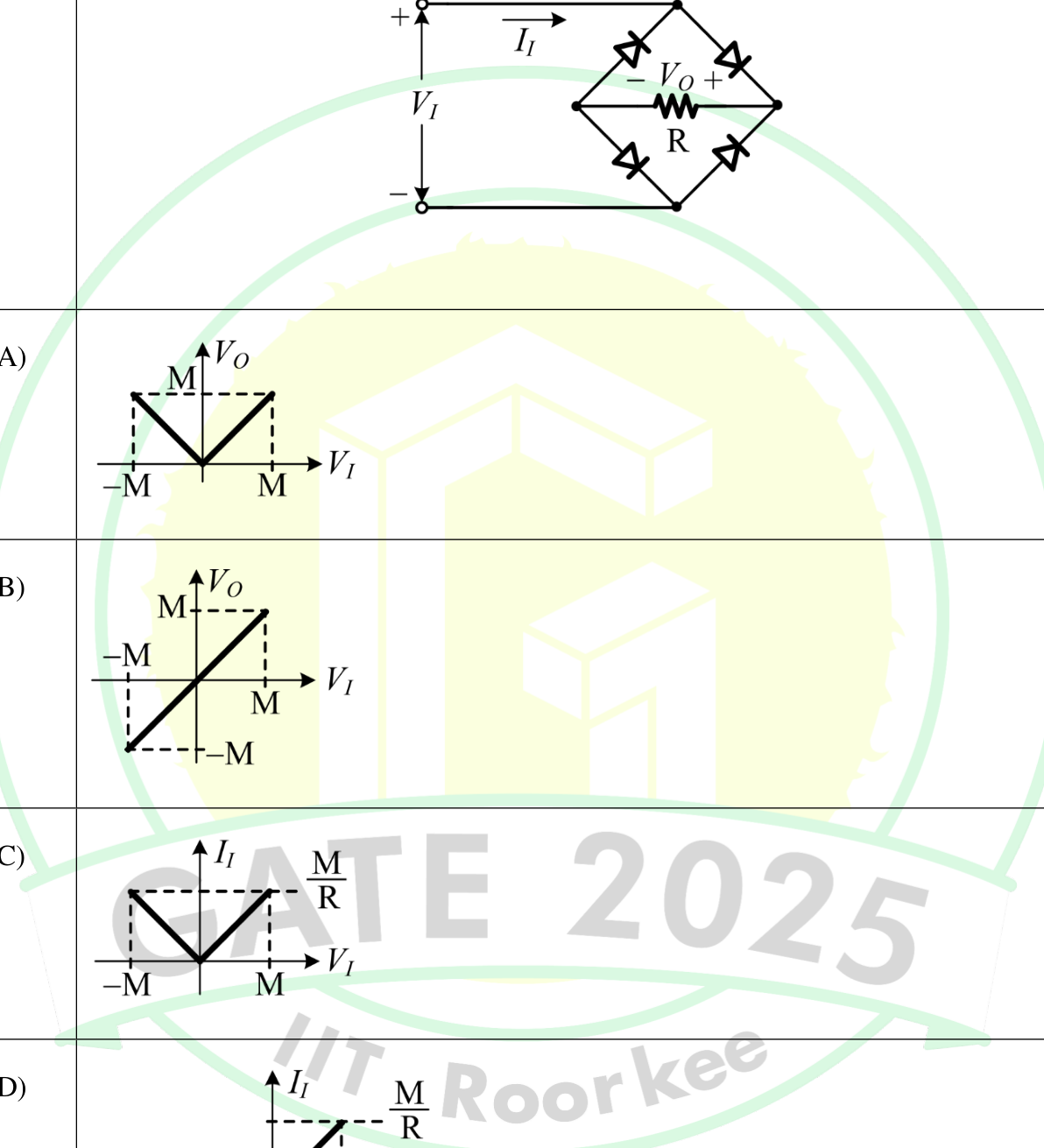
- Question 56Analog Circuitsmsq2 marksAll diodes in the circuit are ideal. Which plot(s) is/are correct as (in Volts) is swept from to ? (See figure.)
- A.(A)✓
- B.(B)
- C.(C)
- D.(D)✓
Answer: A, D
Solution
The diode-bridge full-wave rectifier makes the output voltage (a V-shaped vs , option A) and the input current (option D). Options (A) and (D) are the correct and plots. - A.
- Question 57Engineering Mathematicsnat2 marksTwo fair dice are rolled. Let be the sum of outcomes. The expectation of is ______. (rounded off to two decimal places)
Answer: 6.95 to 7.05
Solution
For a single die ; for the sum of two independent dice . - Question 58Engineering Mathematicsnat2 marksConsider , . For real scalar , the value of is ______. (rounded off to two decimal places)
Answer: 2.95 to 3.05
Solution
The minimizing . The residual norm . - Question 59Communicationsnat2 marksare Bernoulli with joint PMF . The mutual information is ______. (rounded off to two decimal places)
Answer: 0
Solution
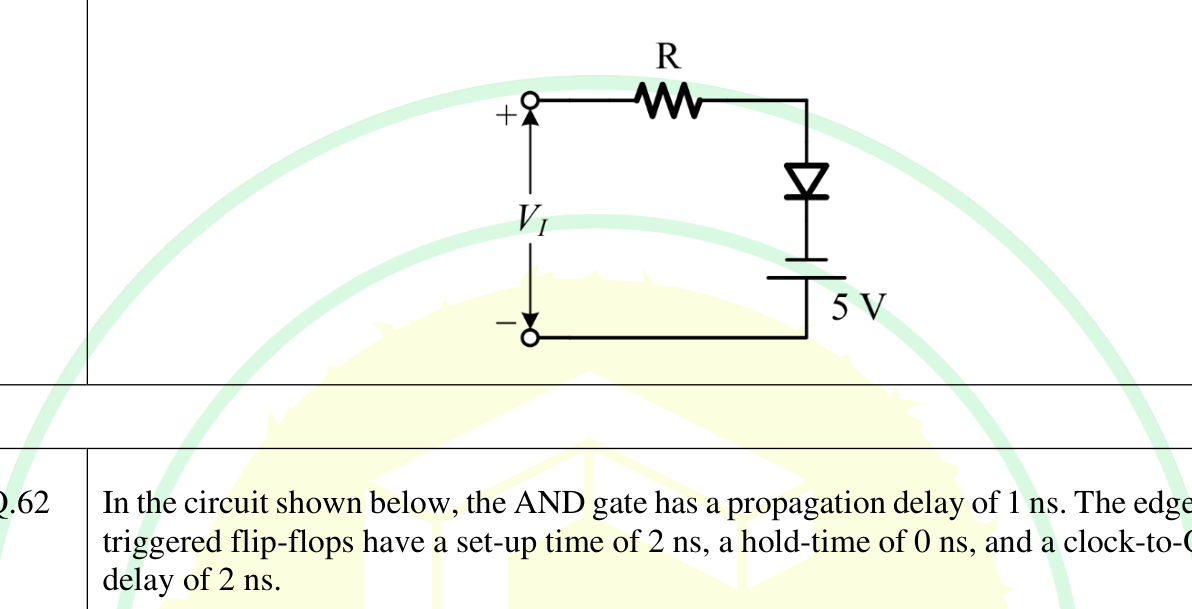
Marginals: ; . Since for all cells (e.g. ), and are independent, so . - Question 60Analog Circuitsnat2 marksThe diode in the circuit is ideal; input V ( in seconds). The time duration (in ms, rounded to two decimals) for which the diode is forward biased during one period is ______. (See figure.)
Answer: 13.32 to 13.34
Solution
The period is ms. From the circuit, the diode conducts when exceeds the clamp level; solving gives a conduction interval of about ms. - Question 61Digital Circuitsnat2 marksIn the circuit, the AND gate has a 1 ns propagation delay; the edge-triggered flip-flops have setup time 2 ns, hold time 0 ns, clock-to-Q delay 2 ns. The maximum clock frequency (in MHz, rounded to nearest integer) with no setup violations is ______. (See figure.)
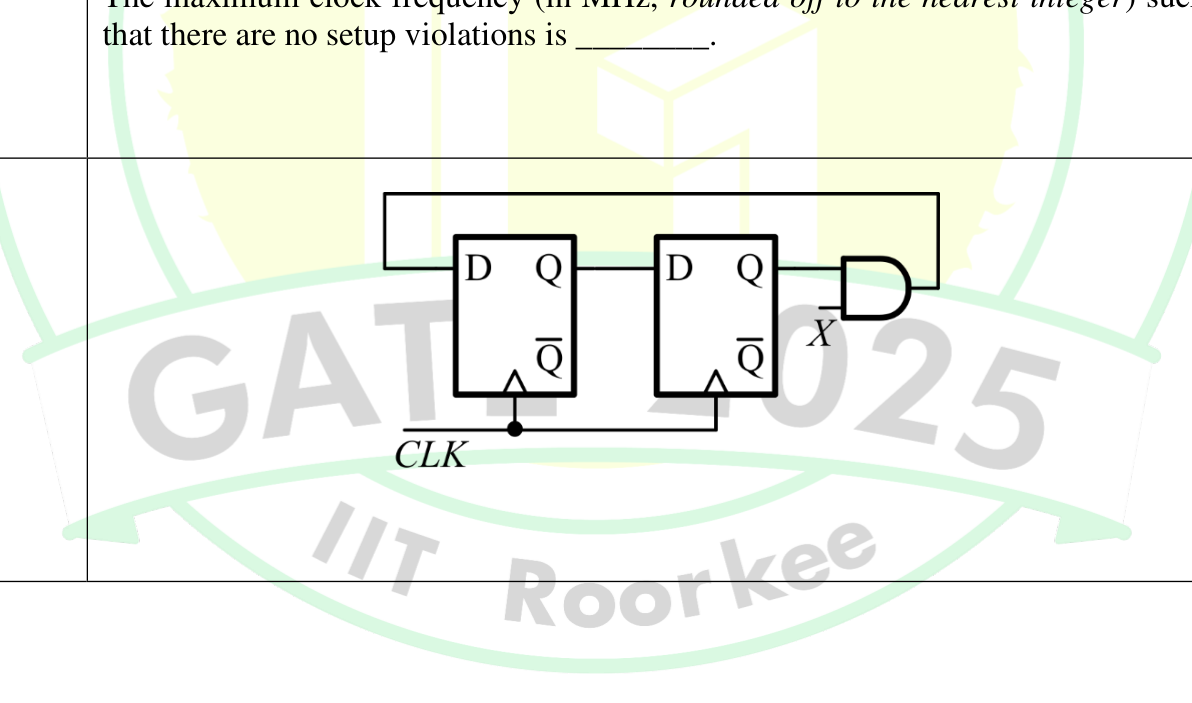
Answer: 200
Solution
Minimum clock period ns. Max frequency MHz. - Question 62Electronic Devicesnat2 marksAn ideal Ge p-n diode has reverse saturation current A at 300 K. The voltage (in Volts, rounded to two decimals) to apply for a forward current of 100 mA at 300 K is ( J/K, C):
Answer: 0.23 to 0.24
Solution
V. - Question 63Electromagneticsnat2 marksA 50 lossless line is terminated with . If the average incident power is 10 mW, the average power delivered to the load (in mW, rounded to one decimal) is ______.
Answer: 6.3 to 6.5
Solution
Reflection coefficient , . Power delivered mW. - Question 64Electromagneticsnat2 marksTwo resistors are connected in a loop of area on the x-y plane (see figure). A time-varying flux density T is applied along . The magnitude of the loop current (in Amperes, rounded to two decimals) is ______.
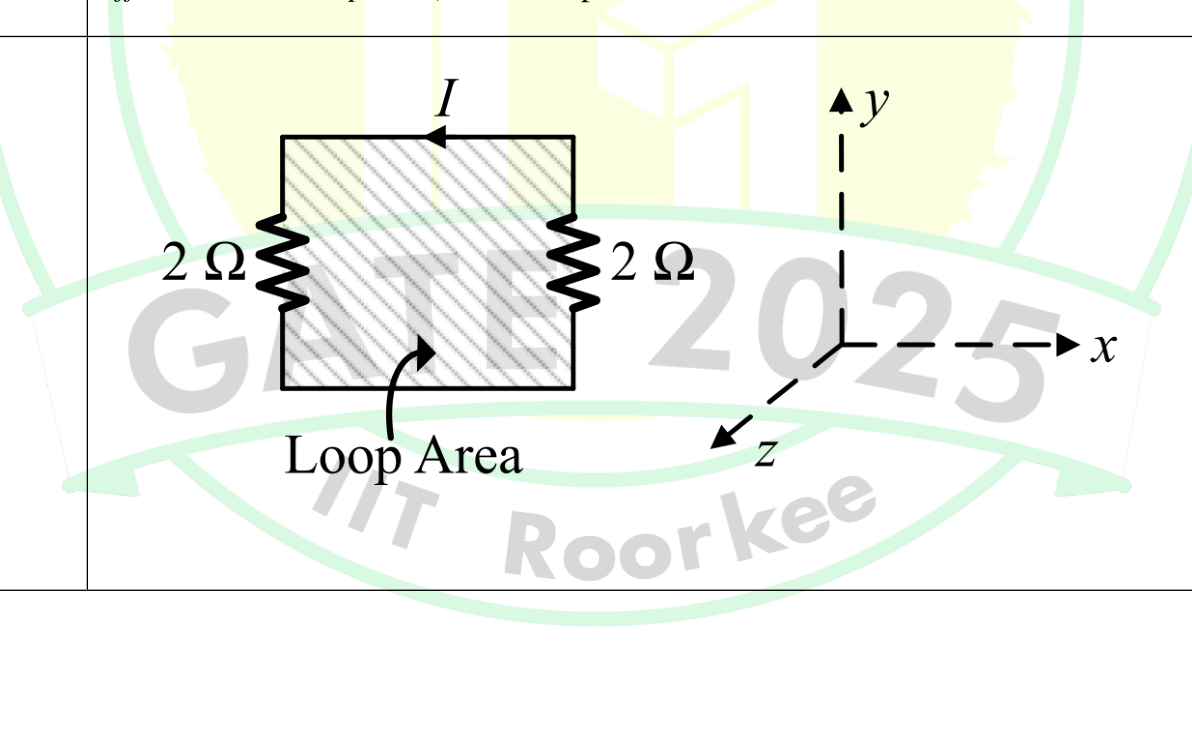
Answer: 0.62 to 0.63
Solution
EMF V. With the two resistors from the figure totalling (series) , A. - Question 65General Aptitudemcq1 markWhich one of the following plots represents , where is a non-zero real number? (See figure.)
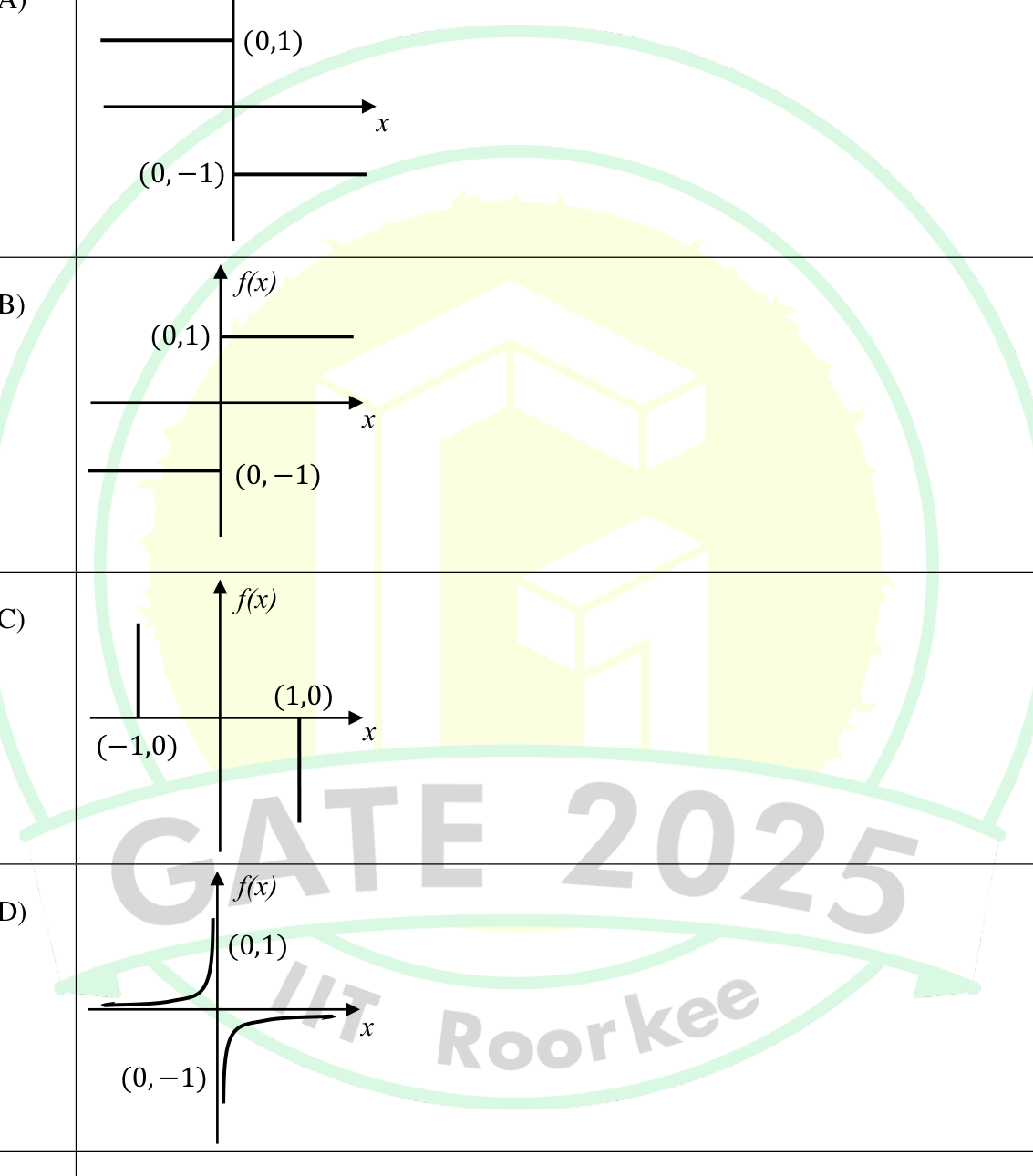
- A.(A)✓
- B.(B)
- C.(C)
- D.(D)
Answer: A
Solution
For , ; for , . So is on the left and on the right (a step from to ) — option (A). - A.
Practice the full paper with a timer
Attempt GATE EC 2025 in the exact GATE interface and get a detailed score and topic-wise analysis — free.
Create free account →